Showing posts with label Anime. Show all posts

Wednesday, 2 July 2014

Japan Expo

Japan Expo is a huge annual event that takes place in the Paris-Nord Villepinte Exhibition Center and is commonly accepted as the biggest festival about Japanese Culture in Europe. It runs from the 2 of June all the way to the 6th. It is definitely on my bucket list.

History of Japan Expo

In France anime is quite popular and over the years a rather large fan base has been created. People watching anime become more and more drawn to Japanese culture and want to learn about it and experience some of it. The Japan Expo was created to fulfill this need, it is mainly and anime convention but also has Games and many other attractions including special guests and even ninjas!

What Happens at Japan Expo

There are many events over the course of Japan Expo ranging from Fashion to anime to manga to video games and toys. There are contests and games to play and screening of different animes. There is even a place for aspiring artists to draw and the chance to meet some of the voices in some of the animes in France. It's definitely something that anime hardcore anime/manga/Japan fan should experience at some point in their life.

Their Website for more information
http://www.japan-expo-paris.com/

Thursday, 26 June 2014

Fred's Phrases: Anime: Fruits Basket Vocabulary

Earlier this week we reviewed the anime 'Fruits Basket' so why don't we learn a bit of the vocab used in the anime?

Daoist (Taoist) symbols carved in stone: yin-y...
Daoist (Taoist) symbols carved in stone: yin-yang and animals of the Chinese zodiac. Qingyanggong temple, Chengdu, Sichuan, China. (Photo credit: Wikipedia)

Anime Vocabulary Lesson 1: Fruits Basket

Animals of the Zodiac
Eng:             Jap:              Kanji
Mouse:        Nezumi :       鼠
Ox:              Osuushi:       雄牛
Tiger:           Tora:            虎
Rabbit:         Usagi:          ウサギ
Dragon:        Ryū:            竜
Snake:          Hebi:            蛇
Horse:          Uma:            馬
Sheep:          Hitsuji:         羊
Monkey:       Saru:            猿
Rooster:        Ondori:        雄鶏
Dog:             Inu:              犬
Pig:               Buta:            豚
And the extra...
Cat:               Neko:          猫

Miscellaneous words
Landslide:    Jisuberi:        地滑り
Handsome:  Hansamu:      ハンサム
Schoolgirl:   Joshi seito:    女子生徒
Hot spring:   Onsen:          温泉
Curse:          Noroi:           呪い
Hug:            Hōyō:            抱擁


Anime Review: Fruits Basket

This is a brand new feature on the Smiletalk Blog I hope you enjoy, Updates will also be posted on the Smiletalk facebook page so please like so you don't miss an episode

The cover of the first volume of the Fruits Ba...
The cover of the first volume of the Fruits Basket manga released by Tokyopop on February 10, 2004 in North America. (Photo credit: Wikipedia)
Fruits Basket

Comedy/Drama
26 Episodes (Approx 24minutes each)
Age Rating: 13+

Synopsis

The story circles around our main character Hondu Tooru (Tohru) and the cursed children of the zodiac. Hondu Tooru's mother has passed away leaving her alone in the world. The ditzy girl is determined to do her best and continue her school life despite living in a tent. She ends up camping in the garden of the Souma's and this is where our adventure begins. Our unfortunate Souma's live under the curse of the zodiac so that every time they are hugged they transform into their corresponding zodiac animal. It makes for some true comedic moments and will definitely make you smile.


Verdict

One of the cutest anime's I have ever watched with a lovely story and wonderful characters. Every so often it will throw you into a plunge pool of emotion which takes you completely off guard. All in all it is a wonderful story with characters that you can love and sympathise with. Sometimes I think everyone just needs a hug.

Sites Hosting Fruits Basket
Remember hosting is expensive, to help support sites that host your favorite anime's be sure to temporarily disable your ad blocker
Dubbed/Subbed: AnimeFreaks.TV
Dubbed: Watch Dub
Manga: MangaFox

Learn The Vocabulary From 'Fruits Basket' With Fred


Monday, 7 April 2014

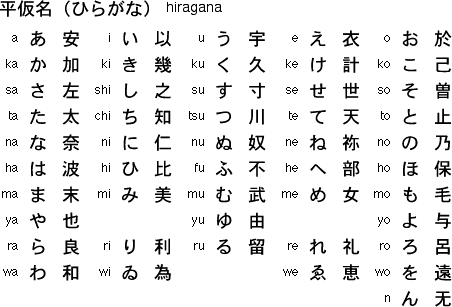
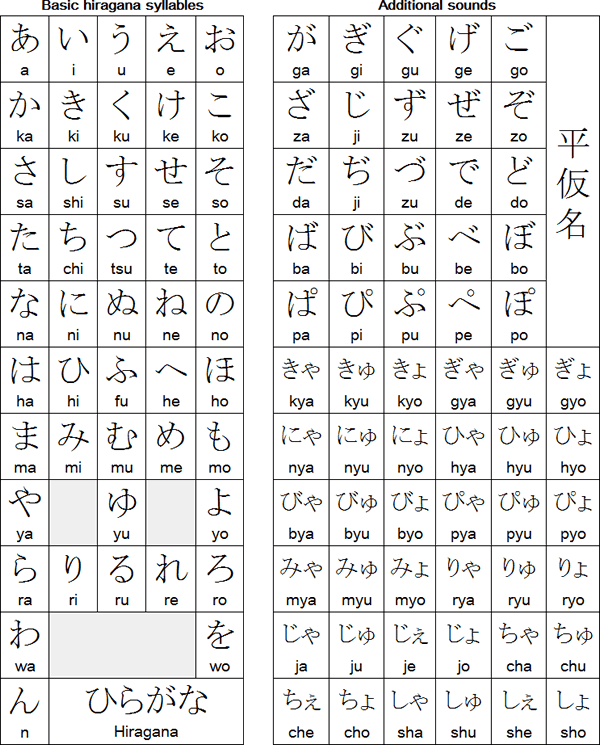
Kate's Classes: Hiragana


Wired Kana: Hiragana and Katakana Practice She...
Wired Kana: Hiragana and Katakana Practice Sheet - 1 (Photo credit: ryanthewired)
Japanese hiragana me mincho
Japanese hiragana me mincho (Photo credit: Wikipedia)
If you are learning Japanese on your own you should remember that it is important to practice your writing as well as reading, For this I recommend you use a practice sheet that you can print out and use. I learnt using practice sheets like this one and did one page everyday till i felt confident. I later moved on to using a sum copy and after that regular lined paper. It's important in the beginning to take baby steps and reward yourself frequently so you are not discouraged. I learnt to recognize the hiragana using hiragana games and when I was learning to write them I said allowed what they were.

Hiragana is vital to learning japanese so dive right in and use these fantastic resources to learn it

practice sheet (pdf)
hiragana game 1
hiragana game 2
hiragana game 3
Hiragana Chart
Hiragana Chart 2
How to write video
Writing game
Hiragana Practice


Enhanced by Zemanta

Friday, 4 April 2014

Miso Soup


Hello! I'm Chloe and this is my kitchen!
A bowl of miso soup
A bowl of miso soup (Photo credit: Wikipedia)
Here we talk about cool Japanese foods and I even give you recipes! Today's cool Japanese food is....
Miso
 (みそ)
ヒラツメガニの味噌汁(miso soup)
ヒラツメガニの味噌汁(miso soup) (Photo credit: Wikipedia)

Miso Soup
Miso Soup (Photo credit: carlosj)

Miso is just one of those awesome Japanese seasonings that not everyone has heard of. It is made by fermenting soybeans with salt and a fungus known as kōjikin in Japan. Sometimes rice is included to make the delicious gloopy paste. Just add a little dashi soup stock and you have some tasty miso soup (misoshiru) on your hands! Surely the king of staple foods.

Miso is rich in vitamins and high in proteins and was even around in feudal Japan. Most of the time it has a delicious salty taste but both the taste and smell change depending on how it was fermented.
Miso has quite a lot of variety so it's worth
experimenting with.

Miso Soup
Miso Soup (Photo credit: Wikipedia)
Here is a simple recipe for Miso Soup that I hope you will enjoy!
Vegetarian Friendly!

Ingredients:

4 cups water
1/3 cup miso
3 green onions (scallions), chopped
1 tbsp shredded nori or wakame seaweed
1/2 block firm silken tofu, cut into 1 inch cubes
dash soy sauce (optional)
1/2 tsp sesame oil (optional)

Prep Time: 5 minutes

Cook Time: 5 minutes

Yield: Serves: 3-4

Instructions:


  1. Get a medium sized saucepan and put in you water and dashi packet (be sure to give it a good stir!).
  2. Bring it to boil on medium heat. When it boils reduce it to a simmer for approximately five minutes.
  3. Make sure you've gotten rid of that Dashi packet. Get a Tbsp. of miso and mix it in with your dashi. Kepp on doing it till all of the miso is used up.
  4. you can try adding tofu to dilute it if you like. Just cut it into neat cubes and plop it in, give it a gentle stir. You of course don't have too but it is tasty.
  5. Get some lovely soak dried wakame and put it in some water for a good ten minutes or so.
  6. While that's soaking slice up a nice green onion and serve it in a bowl with your wakame when you're ready,
  7. Put you miso soup on simmer till it heated through and then serve.
Top Tips
Kombu Dashi is the best for vegetarians.
Don't boil the miso because it ruins the taste.
Taste as you go!

I hope you enjoyed this lesson! Why don't you post a response on Smiletalk about your experience making miso soup!


Return to Classroom
Enhanced by Zemanta

Tuesday, 1 April 2014

Phrases: Greetings


"HELLO"
"HELLO" (Photo credit: Odd.note)
Good Morning.
Ohayou.
おはよう。

Good Afternoon.
Konnichiwa.
こんにちは。

Good evening. 
Konbanwa. 
こんばんは。

Good bye. 
Sayonara. 
さよなら。
Bed Jump
Bed Jump (Photo credit: jamesjyu)

See you later. 
Dewa mata. 
ではまた。

See you tomorrow. 
Mata ashita. 
また明日。

How are you? 
Genki desu ka.
元気ですか。

Fred's Phrases

Enhanced by Zemanta

Saturday, 29 March 2014

Fred's Phrases

Hello and welcome to the classroom. This is where you can find phrases from lessons listed to date. The list keeps on growing and growing! if you have any suggestions comment below or send an email to bigonecomic@gmail.com with the subject 'Smiletalk'

Lesson 1: Greetings
Lesson 2: Phrases for Eating
Lesson 3: Kanji Crunch: Nature
Enhanced by Zemanta

Wednesday, 26 March 2014

30 Prompts

Japan
Japan (Photo credit: YoTuT)
English: Kinkaku-ji (Golden Pavilion Temple), ...
English: Kinkaku-ji (Golden Pavilion Temple), Kyoto, Kyoto Prefecture, Japan Français : Kinkaku-ji: le Pavillon d'Or, Kyoto, préfecture de Kyoto, Japon (Photo credit: Wikipedia)
Here are 30 prompts for you to try on Smiletalk


  1. Some items you find on a menu (tea, chips).
  2. Some terms for describing the weather.
  3. Colours and whats associated with them (red=stop).
  4. Describing a famous painting such as the mona lisa.
  5. Recipe for a healthy lunch
  6. Things you can do in your local area
  7. Etiquette at the dinner table
  8. Your favorite tv show and who's in it
  9. Terms for describing family
  10. Greetings & Goodbyes
  11. Names of items in your bathroom
  12. Names of items in your bedroom
  13. Describe an animal naming all it's different parts (horns, paws, rear legs, flippers)
  14. A trip to a zoo (real or imagined)
  15. What you know about Japan
  16. How long have you been learning Japanese
  17. What motivates you?
  18. Some adjectives to do with something positive
  19. Some verbs associated with movement
  20. What to do in an emergency
  21. A paragraph from a favorite book
  22. Talk about your favorite character from an anime or manga
  23. Describe a drinking glass
  24. Talk about what you think is important for a foreigner to know
  25. Talk about a famous historical figure
  26. Talk about your dream vs battle (e.g Chuck Norris vs Batman)
  27. Talk about places you've been
  28. Give some trivia
  29. Read a poem
  30. What you hope to gain by learning a second language.

Enhanced by Zemanta