Showing posts with label Tokyo. Show all posts

Sunday, 6 July 2014

The War Against War in Japan

In Japan, current plans for military reforms have caused uproar in Tokyo and have lead to 40,000 People protesting outside of the Japanese prime minister's office.

What Military Reforms did Japan have Planned?

The military reforms that the Japanese government had planned prior to the protests were to change parts of the constitution to allow Japan to expand its military role and allow troops to be deployed overseas. Many fear that this would lead Japan into becoming a war mongering fascist country. Despite the protests and the passionate immolation of one protester it would seem that the Japanese government plans to go right on ahead against the wishes of the people.

The War on Article 9

Article 9 of the Japanese Constitution outlaws war as a way to settle international disputes that involve the state. This constitution came into effect on May 3, 1947 after World war II. It was put in place in an effort to promote peace based on justice and order. Within the article it is mentioned that armed forces capable of being involved in a war will not be maintained (apart from the de facto armed forces A.K.A The Japan Self-Defense Forces who are more akin to peacekeepers than soldiers). 
The Abe administration plans to change this and therefore move away from this peaceful way of thinking and thus it is easy to understand the uproar it has cause

Sunday, 18 May 2014

Mifune Matsuri

A set on Mifune Matsuri 02
A set on Mifune Matsuri 02 (Photo credit: aurelio.asiain)
Mifune Matsuri #58
Mifune Matsuri #58 (Photo credit: Christian Kaden)
Guiding a boat during a festival.
Guiding a boat during a festival. (Photo credit: Wikipedia)
Mifune Matsuri is a festival held in annually in May to celebrate Kiyohara Yorinari, who was a 12th century Confucian scholar. Mifune Matsuri means 'Festival of the Three Boats'.  Every year during this festival his soul is taken for a walk! His spirit is lead into a portable shrine known as a 'mikoshi' and then lead to a temporary shine on the bank of the Oi river.

A beautiful ritual is then held to transfer Kiyohara Yorinari's soul into a boat known as 'gozabune'. Everyone is dressed in ancient attire and then they head along the Togetsukyo Bridge to board the boats. Their costumes are usually very eye catching and even little children will be dressed up in kimonos for the event.

 Kiyohara Yorinari's boat is taken to the middle of the Oi river where it is parked for two or three hours. The other ships carrying artists and the like then pay their respects by approaching the boat and dancing or reading poetry or some other form of entertainment. Every boat has a niche role, a boat will be carrying musicians who play music, while dancers are on a separate boat and so on.

After all this excitement Kiyohara's soul is transfered to another temporary resting place to recover from the festival before the trip home.

Enhanced by Zemanta

Sunday, 20 April 2014

10 Culture Points to Survive in Japan


  1. Keep business cards safe. If you receive a business card treat it with the utmost care and be seen to do so.
  2. Be clean before you enter the public bath. Don't pee in the bath!
  3. No talking in the elavator. It's really really rude.
  4. Take your shoes off before entering a house. Common cutesy.
  5. Never stick your chopsticks into your food so they stand vertically. It's bad luck
  6. Unless you have medical reasons or are good at lying about having a condition don't refuse a drink.
  7. Don't sit at the head of the table unless you are told to.
  8. Do not season your food without tasting. It's an insult to the chef.
  9. Don't imitate anime characters in practical speech, you'll look like a fool unless you are cosplaying.
  10. Bow upon meeting someone, if you don't know for how long it's best to bow deeper and longer then to be thought of as rude.


Enhanced by Zemanta

Monday, 7 April 2014

Kate's Classes: Hiragana


Wired Kana: Hiragana and Katakana Practice She...
Wired Kana: Hiragana and Katakana Practice Sheet - 1 (Photo credit: ryanthewired)
Japanese hiragana me mincho
Japanese hiragana me mincho (Photo credit: Wikipedia)
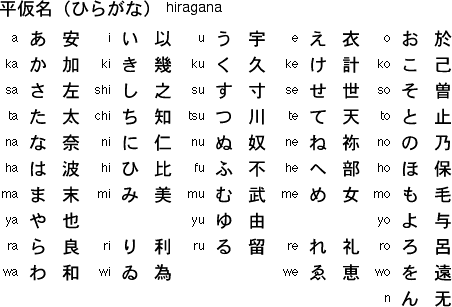
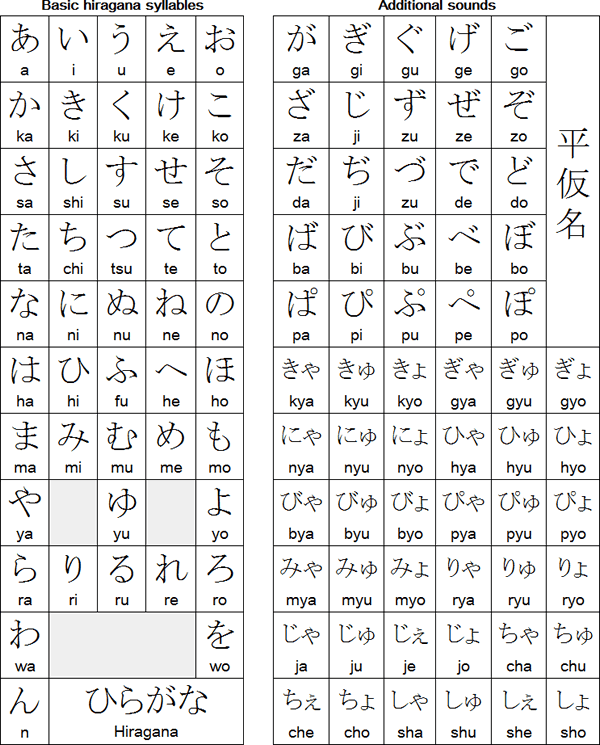
If you are learning Japanese on your own you should remember that it is important to practice your writing as well as reading, For this I recommend you use a practice sheet that you can print out and use. I learnt using practice sheets like this one and did one page everyday till i felt confident. I later moved on to using a sum copy and after that regular lined paper. It's important in the beginning to take baby steps and reward yourself frequently so you are not discouraged. I learnt to recognize the hiragana using hiragana games and when I was learning to write them I said allowed what they were.

Hiragana is vital to learning japanese so dive right in and use these fantastic resources to learn it

practice sheet (pdf)
hiragana game 1
hiragana game 2
hiragana game 3
Hiragana Chart
Hiragana Chart 2
How to write video
Writing game
Hiragana Practice


Enhanced by Zemanta

Friday, 4 April 2014

Miso Soup


Hello! I'm Chloe and this is my kitchen!
A bowl of miso soup
A bowl of miso soup (Photo credit: Wikipedia)
Here we talk about cool Japanese foods and I even give you recipes! Today's cool Japanese food is....
Miso
 (みそ)
ヒラツメガニの味噌汁(miso soup)
ヒラツメガニの味噌汁(miso soup) (Photo credit: Wikipedia)

Miso Soup
Miso Soup (Photo credit: carlosj)

Miso is just one of those awesome Japanese seasonings that not everyone has heard of. It is made by fermenting soybeans with salt and a fungus known as kōjikin in Japan. Sometimes rice is included to make the delicious gloopy paste. Just add a little dashi soup stock and you have some tasty miso soup (misoshiru) on your hands! Surely the king of staple foods.

Miso is rich in vitamins and high in proteins and was even around in feudal Japan. Most of the time it has a delicious salty taste but both the taste and smell change depending on how it was fermented.
Miso has quite a lot of variety so it's worth
experimenting with.

Miso Soup
Miso Soup (Photo credit: Wikipedia)
Here is a simple recipe for Miso Soup that I hope you will enjoy!
Vegetarian Friendly!

Ingredients:

4 cups water
1/3 cup miso
3 green onions (scallions), chopped
1 tbsp shredded nori or wakame seaweed
1/2 block firm silken tofu, cut into 1 inch cubes
dash soy sauce (optional)
1/2 tsp sesame oil (optional)

Prep Time: 5 minutes

Cook Time: 5 minutes

Yield: Serves: 3-4

Instructions:


  1. Get a medium sized saucepan and put in you water and dashi packet (be sure to give it a good stir!).
  2. Bring it to boil on medium heat. When it boils reduce it to a simmer for approximately five minutes.
  3. Make sure you've gotten rid of that Dashi packet. Get a Tbsp. of miso and mix it in with your dashi. Kepp on doing it till all of the miso is used up.
  4. you can try adding tofu to dilute it if you like. Just cut it into neat cubes and plop it in, give it a gentle stir. You of course don't have too but it is tasty.
  5. Get some lovely soak dried wakame and put it in some water for a good ten minutes or so.
  6. While that's soaking slice up a nice green onion and serve it in a bowl with your wakame when you're ready,
  7. Put you miso soup on simmer till it heated through and then serve.
Top Tips
Kombu Dashi is the best for vegetarians.
Don't boil the miso because it ruins the taste.
Taste as you go!

I hope you enjoyed this lesson! Why don't you post a response on Smiletalk about your experience making miso soup!


Return to Classroom
Enhanced by Zemanta

Tuesday, 1 April 2014

Phrases: Greetings


"HELLO"
"HELLO" (Photo credit: Odd.note)
Good Morning.
Ohayou.
おはよう。

Good Afternoon.
Konnichiwa.
こんにちは。

Good evening. 
Konbanwa. 
こんばんは。

Good bye. 
Sayonara. 
さよなら。
Bed Jump
Bed Jump (Photo credit: jamesjyu)

See you later. 
Dewa mata. 
ではまた。

See you tomorrow. 
Mata ashita. 
また明日。

How are you? 
Genki desu ka.
元気ですか。

Fred's Phrases

Enhanced by Zemanta

Wednesday, 26 March 2014

30 Prompts

Japan
Japan (Photo credit: YoTuT)
English: Kinkaku-ji (Golden Pavilion Temple), ...
English: Kinkaku-ji (Golden Pavilion Temple), Kyoto, Kyoto Prefecture, Japan Français : Kinkaku-ji: le Pavillon d'Or, Kyoto, préfecture de Kyoto, Japon (Photo credit: Wikipedia)
Here are 30 prompts for you to try on Smiletalk


  1. Some items you find on a menu (tea, chips).
  2. Some terms for describing the weather.
  3. Colours and whats associated with them (red=stop).
  4. Describing a famous painting such as the mona lisa.
  5. Recipe for a healthy lunch
  6. Things you can do in your local area
  7. Etiquette at the dinner table
  8. Your favorite tv show and who's in it
  9. Terms for describing family
  10. Greetings & Goodbyes
  11. Names of items in your bathroom
  12. Names of items in your bedroom
  13. Describe an animal naming all it's different parts (horns, paws, rear legs, flippers)
  14. A trip to a zoo (real or imagined)
  15. What you know about Japan
  16. How long have you been learning Japanese
  17. What motivates you?
  18. Some adjectives to do with something positive
  19. Some verbs associated with movement
  20. What to do in an emergency
  21. A paragraph from a favorite book
  22. Talk about your favorite character from an anime or manga
  23. Describe a drinking glass
  24. Talk about what you think is important for a foreigner to know
  25. Talk about a famous historical figure
  26. Talk about your dream vs battle (e.g Chuck Norris vs Batman)
  27. Talk about places you've been
  28. Give some trivia
  29. Read a poem
  30. What you hope to gain by learning a second language.

Enhanced by Zemanta