Showing posts with label Asia. Show all posts

Monday, 30 June 2014

Nagoshi no harae


English: Icon of Shinto 日本語: 神道のアイコン
English: Icon of Shinto 日本語: 神道のアイコン (Photo credit: Wikipedia)
ooharae-chinowa-summer,katori-jingu,katori-cit...
ooharae-chinowa-summer,katori-jingu,katori-city,japan (Photo credit: Wikipedia)

History of Nagoshi no Harae

Nagoshi no Harae is a purification ceremony that happens on the last day of the sixth month of the lunar calendar. In olden times a great purification was held twice a year (once every six months) but over the years the end of the year purification began to die out as the mid-year purification gained unprecedented popularity. The mid-year ceremony became grander and more magnificent year by year until it became what it is today.

Shinto and Nagoshi no Harae

Nagoshi no Harae is very much related to the Shinto belief system in Japan. The Oharahi-no-Kotoba is a prayer that is said during daily Shinto shrine pursuits.

What happens at Nagoshi no Harae?

Shrines hold a grand purification ceremony in late June called Nagoshi no Harae. People come to the ceremony to atone for the sins they have so far committed in the first half of the yeah and pray for good health and positivity in the months to come by walking through a large wreath made of miscanthus reeds called a 'chinowa'. 
Some shrines supply their guests with little paper men that are known as 'hitogata' or paper scapegoats. these are used to help purify a person. They are meant to rub it all over their body to absorb the sin and badness that has polluted their body. This badness and negativity is knows as 'kegare'. The paper scapegoat is then thrown awayby floating it along a river or by burning it.

Saturday, 21 June 2014

Three Excellent Documentaries on Japan

You love Japan? How about you study up and watch these awesome top rated documentaries?

Life in Japan: This one is about actual life in Japan and the experiences of various foreigners. This personally my favorite documentary and is something that really solidified my resolve to learn the Japanese language.


Japan by Bicycle: It's subbed but still an amazing documentary.

Secrets of the Samurai Sword: is an excellent documentary with a lot of replay value.


What are your favorite documentaries about Japan? comment below or leave a message on our facebook and we will include them in our next list of 'what to watch documentaries'.

Tuesday, 3 June 2014

Chopsticks

English: Chopsticks for cooking Français : boi...
English: Chopsticks for cooking Français : bois à manger (Photo credit: Wikipedia)

You are probably well aware that in Japan rather than using knives or forks, chopsticks are the most common eating implement. How much do you really know about chopsticks?


The chopsticks お箸(Ohashi)

At the home in Japan, each family has their own chopsticks. Parents tend to use long chopsticks and children use short chopsticks. There are a variety of colors and designs in department and other stores in Japan.

Many Japanese people carry around their own set of chopsticks. By doing this they avoid having to use the cheap throw away chopsticks (waribashi) that are often supplied at bento shops. Most Japanese find chopsticks easier to use that a knife and fork.

When eating at a restaurant in Japan you will see a Chopstick rest (箸置き hashioki) on the table. If there is no chopstick rest and you need to put your chopsticks down then simple fold the wrapper your chopsticks came in, into an accordion shape and use that as the rest.

Never ever ever

  1. Lift chopstick above mouth height.
  2. Tear food apart by holding one chopstick in each hand
  3. Shake off liquid on tip of chopstick.
  4. Swing hand that is holding chopstick.
  5. Shovel food into mouth with chopsticks, with the edge of you mouth on the rice bowl
  6. Let chopsticks roam around plate while you are deciding what next to eat.
  7. Hold chopsticks with hand that is already holding dish.
  8. Put food in your mouth that is dripping.
  9. Lick cop sticks.
  10. Use chopsticks upside-down.
  11. Eat with unmatched pair of chopsticks.
  12. Tap plate with chopsticks.
  13. Pass food from one person to another using chopsticks.
  14. Use as toothpick.

Enhanced by Zemanta

Wednesday, 28 May 2014

Smiletalk website update

I am excited to tell you avid Smiletalk users and eager learners, about Smiletalks latest features. As you know the site at the moment is still in it's infancy and with each passing month we boldly stride forward to improve it for the users. This month we have added a more social element to the website but stay tuned because even bigger and better updates are in the works. Thank you so much for your support!
Now lets take a closer look at these new features!

The Latest Features

Smiles

English: Hitch-hiker's gesture Русский: Жест а...
English: Hitch-hiker's gesture Русский: Жест автостопщика (Photo credit: Wikipedia)
Hey you, someone just gave you a smile! This means that they found your recording helpful and wanted to show their appreciation with a little smile. It's basically a thumbs up meaning you did a good job and just a little something to help motivate you!

This will help you decide on the content you can upload by seeing what people like. It will also help you to improve your posts by mimic the ones you made that got a lot of smiles.


Comments

We have finally created a comments feature! This means that people can now comment on your talk to tell you if it was helpful or not and to thank you for uploading. You can also comment on other users talk and maybe even ask for a specific talk! More features like this coming real soon

Plays

Now you can see how many time your talk has been played. If it is being played a lot then you know a lot of users are using it. You should feel proud that you are helping break down the language barrier!

Thank you all once again for your support and remember, by just sharing a few words you are helping billions of people by providing listening comprehensions


Enhanced by Zemanta

Sunday, 18 May 2014

Mifune Matsuri

A set on Mifune Matsuri 02
A set on Mifune Matsuri 02 (Photo credit: aurelio.asiain)
Mifune Matsuri #58
Mifune Matsuri #58 (Photo credit: Christian Kaden)
Guiding a boat during a festival.
Guiding a boat during a festival. (Photo credit: Wikipedia)
Mifune Matsuri is a festival held in annually in May to celebrate Kiyohara Yorinari, who was a 12th century Confucian scholar. Mifune Matsuri means 'Festival of the Three Boats'.  Every year during this festival his soul is taken for a walk! His spirit is lead into a portable shrine known as a 'mikoshi' and then lead to a temporary shine on the bank of the Oi river.

A beautiful ritual is then held to transfer Kiyohara Yorinari's soul into a boat known as 'gozabune'. Everyone is dressed in ancient attire and then they head along the Togetsukyo Bridge to board the boats. Their costumes are usually very eye catching and even little children will be dressed up in kimonos for the event.

 Kiyohara Yorinari's boat is taken to the middle of the Oi river where it is parked for two or three hours. The other ships carrying artists and the like then pay their respects by approaching the boat and dancing or reading poetry or some other form of entertainment. Every boat has a niche role, a boat will be carrying musicians who play music, while dancers are on a separate boat and so on.

After all this excitement Kiyohara's soul is transfered to another temporary resting place to recover from the festival before the trip home.

Enhanced by Zemanta

Monday, 7 April 2014

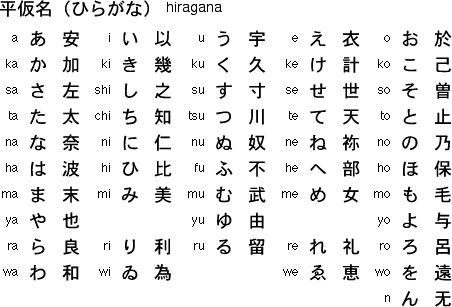
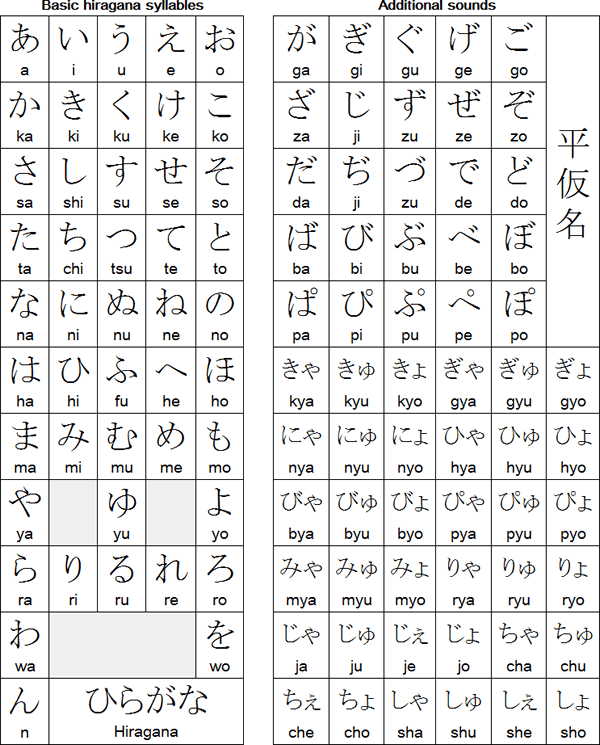
Kate's Classes: Hiragana


Wired Kana: Hiragana and Katakana Practice She...
Wired Kana: Hiragana and Katakana Practice Sheet - 1 (Photo credit: ryanthewired)
Japanese hiragana me mincho
Japanese hiragana me mincho (Photo credit: Wikipedia)
If you are learning Japanese on your own you should remember that it is important to practice your writing as well as reading, For this I recommend you use a practice sheet that you can print out and use. I learnt using practice sheets like this one and did one page everyday till i felt confident. I later moved on to using a sum copy and after that regular lined paper. It's important in the beginning to take baby steps and reward yourself frequently so you are not discouraged. I learnt to recognize the hiragana using hiragana games and when I was learning to write them I said allowed what they were.

Hiragana is vital to learning japanese so dive right in and use these fantastic resources to learn it

practice sheet (pdf)
hiragana game 1
hiragana game 2
hiragana game 3
Hiragana Chart
Hiragana Chart 2
How to write video
Writing game
Hiragana Practice


Enhanced by Zemanta

Friday, 4 April 2014

Miso Soup


Hello! I'm Chloe and this is my kitchen!
A bowl of miso soup
A bowl of miso soup (Photo credit: Wikipedia)
Here we talk about cool Japanese foods and I even give you recipes! Today's cool Japanese food is....
Miso
 (みそ)
ヒラツメガニの味噌汁(miso soup)
ヒラツメガニの味噌汁(miso soup) (Photo credit: Wikipedia)

Miso Soup
Miso Soup (Photo credit: carlosj)

Miso is just one of those awesome Japanese seasonings that not everyone has heard of. It is made by fermenting soybeans with salt and a fungus known as kōjikin in Japan. Sometimes rice is included to make the delicious gloopy paste. Just add a little dashi soup stock and you have some tasty miso soup (misoshiru) on your hands! Surely the king of staple foods.

Miso is rich in vitamins and high in proteins and was even around in feudal Japan. Most of the time it has a delicious salty taste but both the taste and smell change depending on how it was fermented.
Miso has quite a lot of variety so it's worth
experimenting with.

Miso Soup
Miso Soup (Photo credit: Wikipedia)
Here is a simple recipe for Miso Soup that I hope you will enjoy!
Vegetarian Friendly!

Ingredients:

4 cups water
1/3 cup miso
3 green onions (scallions), chopped
1 tbsp shredded nori or wakame seaweed
1/2 block firm silken tofu, cut into 1 inch cubes
dash soy sauce (optional)
1/2 tsp sesame oil (optional)

Prep Time: 5 minutes

Cook Time: 5 minutes

Yield: Serves: 3-4

Instructions:


  1. Get a medium sized saucepan and put in you water and dashi packet (be sure to give it a good stir!).
  2. Bring it to boil on medium heat. When it boils reduce it to a simmer for approximately five minutes.
  3. Make sure you've gotten rid of that Dashi packet. Get a Tbsp. of miso and mix it in with your dashi. Kepp on doing it till all of the miso is used up.
  4. you can try adding tofu to dilute it if you like. Just cut it into neat cubes and plop it in, give it a gentle stir. You of course don't have too but it is tasty.
  5. Get some lovely soak dried wakame and put it in some water for a good ten minutes or so.
  6. While that's soaking slice up a nice green onion and serve it in a bowl with your wakame when you're ready,
  7. Put you miso soup on simmer till it heated through and then serve.
Top Tips
Kombu Dashi is the best for vegetarians.
Don't boil the miso because it ruins the taste.
Taste as you go!

I hope you enjoyed this lesson! Why don't you post a response on Smiletalk about your experience making miso soup!


Return to Classroom
Enhanced by Zemanta